I see companies and individuals using AI every day as their creative and marketing department. I would be lying if I said I didn't use it too.
It helps tremendously with output and production. I can get further, faster, than I could a few years ago. The problem is that a lot of what comes out of these tools looks the same. If your brand is supposed to feel like you, that sameness works against you. So here it is, plainly: AI is just a tool, not a designer.
The problem is that everything looks the same
Open a few AI-generated sites, ads, or brand decks in a row and the pattern shows up fast. The same layouts. The same soft gradients. The same polite, empty headlines. The same almost-real photos that do not quite belong to anyone.
That happens because the tools are trained on a huge pile of what already exists. Left on their own, they average everything out. A single prompt, even a detailed one with all the notes you want included, is not enough for AI to figure out how the output should merge with your brand.
Your brand is more than a color palette and a logo dropped into a prompt. It is how you speak, the details you insist on, and the things you would never put on a page. AI does not know that unless a person who does is guiding the work, round after round. This is why a great eye for design, and real expertise in the field, still matter. Maybe more than they did before, because it is so easy to publish something that looks finished and is not.
A prompt is a starting point
I use AI as a starting point. I will say that without apology. In AI design, AI web design, and AI-driven design, it can open a direction or get a first pass on the table so we are not starting from zero. Production is a real part of the job, and the tools help with it.
What they cannot do, on their own, is decide if the work is actually good. They cannot tell you the type is a little too tight, or that a layout might work for one kind of business and do nothing for another. A prompt plus a list of details is a brief, not a finished piece. That call is still a human one.
Massaging, iterating, and the dirty work
Great quality AI output takes massaging, iterating, and guiding. You generate, you cut, you push it again with better direction, and you compare it to the brand, not just to the prompt.
And even then, you may have to step in and do the dirty work yourself: the spacing that feels off, the crop, the awkward sentence, the page that almost works until you rebuild it by hand.
That is not a failure of the tool. It is the job. AI-driven design, the way I practice it, is a professional skill. The tool needs a trained eye, clear direction, and guided revisions. Without those, the output looks generic and recycled, because that is the default.
I love handcrafted details. I also love new technology that makes my life easier. Those two things are not at odds. The details are still the point. The tools are how I get to them with less friction. When a new tool helps me produce, I will use it. When it starts flattening the work into something that could belong to anyone, I slow down and take the wheel.
The person in the driver's seat
I will stand firmly on this: the person in the driver's seat has to be a professional in the industry, someone who can guide the work until it looks the way it needs to look.
Not because designers need to protect their turf. Because someone has to know what "done" looks like, when to accept a result and when to throw it out, and how brand, hierarchy, spacing, and audience fit together.
If you skip that, you get volume without taste: work that looks fine in a screenshot and is easy to forget in real life. I am happy to use the tool. I am not willing to let it decide what the work should be.
Traditionalists, AI-only designers, and hybrids
I see three camps.
There are the traditionalists who refuse to use AI. I understand the instinct. But refusing the tool altogether means refusing a real gain in output and production. Ignoring a useful tool does not make the craft stronger. It just makes the process slower.
Then there are newer designers who only use AI. The risk is that the work never gets past the first convincing draft. If the process is prompt, export, deliver, the brand gets approximated, not interpreted. That is how you end up with a feed, a site, and a deck that all feel like they came from the same place, even when the logos are different.
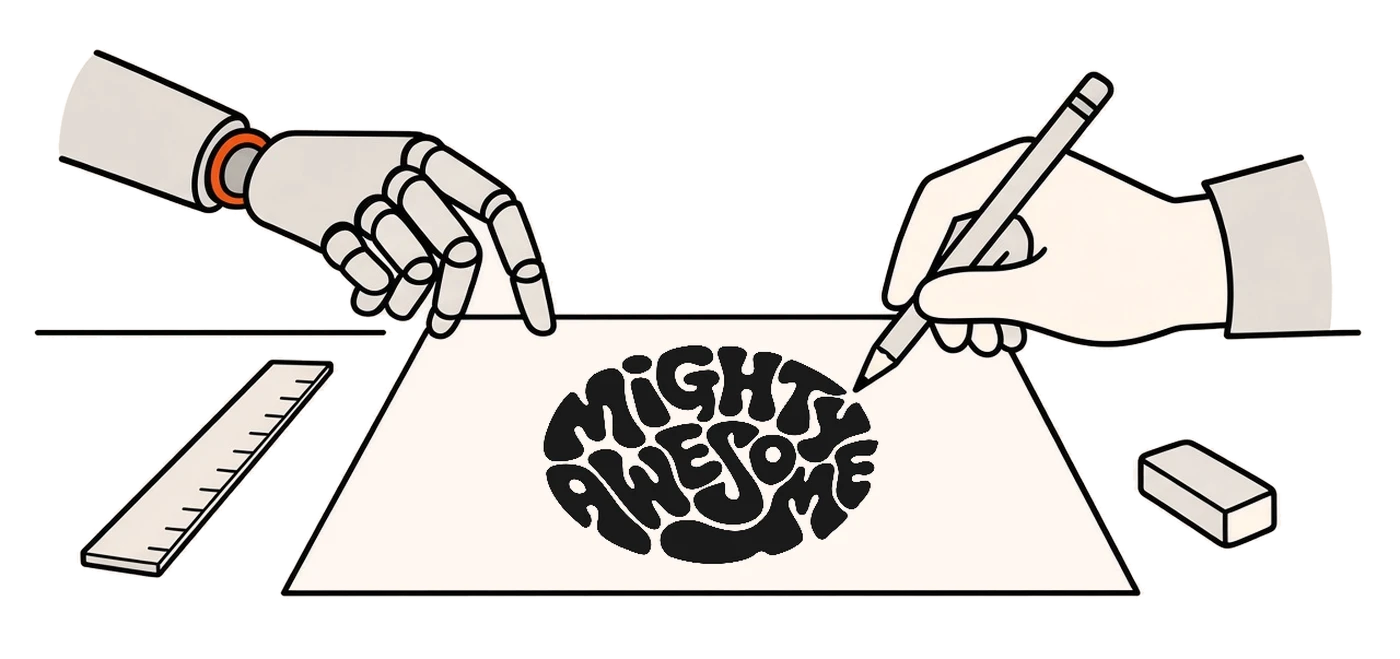
And then there are the hybrids. That is how I see our studio. We blend the best of both worlds. We use AI where it helps us start, explore, and produce. We use a designer's eye, and the slower, handcrafted work, where the tool runs out of taste. Mighty Awesome offers AI-driven design and AI-driven web design, but those services are not "type a prompt and get a brand." They are directed work. The AI is in the room. A professional is still running the meeting.
We grew up in both eras
I think this hybrid stance comes from how we grew up. We were kids in a time when we did not have the internet at our fingertips. You learned by looking closely, making things by hand, and filling the time with drawing or taking something apart. Then the internet fell into our laps while we were still kids and teens. Suddenly there were new tools and new ways to make work, and we had to learn those too.
That in-between is a gift, even if it did not feel like one at the time. We got the patience of the earlier era and the fluency of the one that arrived next. We are not attached to doing everything the old way, and we are not convinced that a new tool should replace judgment. That is the seat I want to stay in. Use the new thing. Keep the eye. Do the dirty work when the output is not there yet.
If you want the work to still look like you
If you have been using AI as your creative department and the work is starting to look like everyone else's, that is not a reason to throw the tools out. It is a reason to put a professional in charge of them.
If you want a partner who will use AI as a starting point, then massage, iterate, and guide it until it fits your brand, that is the work I like doing. Start a project with Mighty Awesome and tell us what you need. We will be honest about where the tools help and where a person still has to step in.